Quick Answer: What Is the Price for a Central Vacuum System?
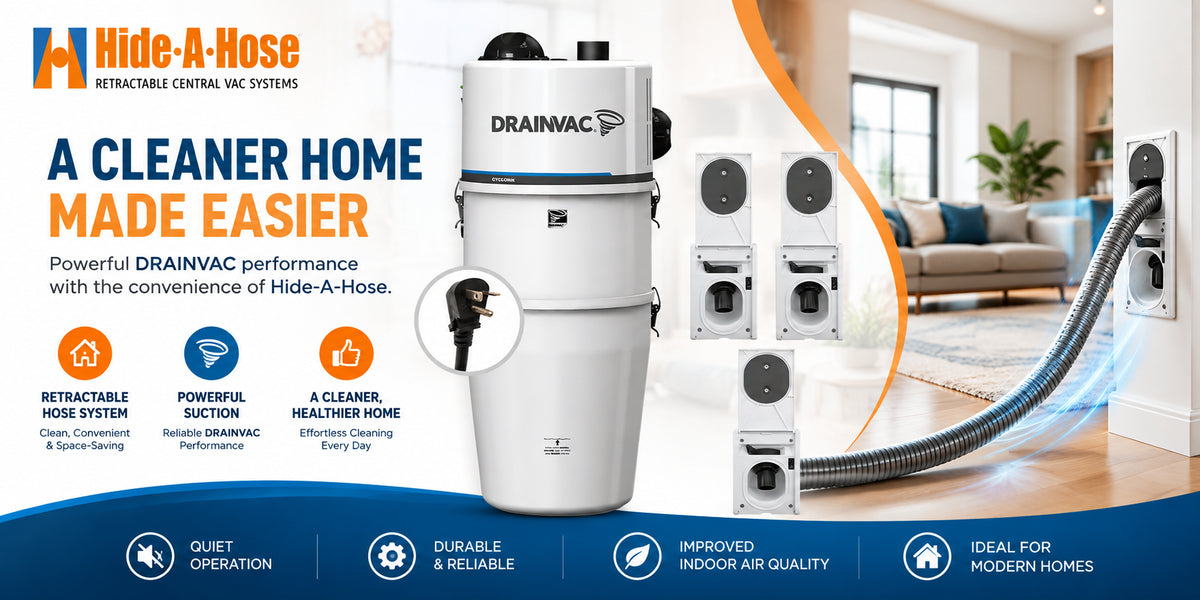
The price for a central vacuum system in Canada depends mainly on the power unit, the number of inlets, the type of hose, and whether you install it yourself or hire a professional. Entry-level power units can start in the high hundreds of dollars, while complete, retractable-hose packages for larger homes can run into the low thousands. As a concrete example, the DrainVac DV1R15-CT Central Vacuum with Hide-A-Hose Complete Installation Package (3 Valve) is listed at $3,229.00 CAD and includes a dual-motor power unit, three retractable hose inlets, three hoses, three wands, and a full tool set for each hose.
That number surprises some shoppers. Others are relieved because they expected more. The truth is that central vacuum pricing is not one number. It is a range shaped by a handful of decisions you control. This guide walks through each decision so you can build a realistic budget before you buy.
Key Takeaways
- A central vacuum system has four cost areas: the power unit, the inlets (valves), the hose and tools, and installation.
- Complete packages usually cost less than buying every component separately because they bundle compatible parts.
- Retractable hose systems such as Hide-A-Hose cost more than standard inlets but remove hose storage and carrying.
- PVC tubing is often bought separately, so confirm what your package includes.
- Installing during new construction or a major renovation is typically cheaper than retrofitting into finished walls.
- Your home's size and the number of inlets matter more to the final price than almost any other factor.
What Is Included in a Central Vacuum System?
Before comparing prices, it helps to understand what you are actually buying. A central vacuum is a whole-home cleaning system. Instead of dragging a heavy machine from room to room, you plug a lightweight hose into a wall inlet, and a powerful motor in your garage, basement or utility room pulls the dirt through hidden tubing into a collection canister.
A complete system has five main parts:
- The power unit. This is the motor and canister, usually mounted on a wall in a garage or utility space. It generates suction and collects debris.
- Inlet valves. These are the wall-mounted openings where you connect the hose. Most homes need one inlet for every 600 to 800 square feet of living space, though layout matters.
- Tubing and fittings. PVC pipe, elbows and couplers form the hidden network connecting each inlet to the power unit.
- Hose and wand. This is the part you handle. It can be a standard hose that you carry, or a retractable hose that stores inside the wall.
- Tools and attachments. Floor brushes, dusting brushes, upholstery tools and crevice tools make the system useful for every surface.
Each of these affects the final price, so let us look at them one at a time.
Cost Breakdown: Where Your Money Goes
1. Power Unit Price
The power unit is usually the biggest single line item. Prices vary with motor strength, canister capacity, filtration and noise control. Power is commonly described in air watts, water lift and airflow (CFM). Higher numbers generally mean stronger suction and the ability to serve more inlets or a larger home.
For example, the DrainVac DV1R15-CT in this package uses two motors rated at 355 air watts each, for a combined 710 air watts. Its listed specifications also include 160 inches of water lift, 106 CFM, a 46-litre canister (marketed as 10 gallons) and a sound level of 70 decibels. It is rated for homes up to 9,500 square feet.
A smaller single-motor unit can cost noticeably less and may be perfectly adequate for a condo or a modest bungalow. A dual-motor unit costs more but gives you the headroom to serve a large house without losing suction at the farthest inlet.
2. Inlet Valves and Installation Hardware
Every inlet you add increases the cost, because each one needs a valve, a trim plate, tubing and fittings. Standard inlets are the least expensive. Retractable systems are pricier per inlet but replace the need to store and carry a hose.
The package in this guide includes three HS5000 valve rough-in kits, three HS5000 valve trim kits and twelve 90-degree elbows, which is the hardware needed for a three-inlet layout.
3. Hoses, Wands and Tools
A basic hose is inexpensive. A retractable hose system is a more significant investment because the hose is housed in the tubing behind the wall and pulled out when needed. In the DrainVac package, you get three Rapid Flex hoses, three Ready Grip direct connect handles, three telescopic metal wands and a three-piece tool set per hose, covering a floor brush, dusting tool, upholstery tool and crevice tool.
4. PVC Tubing
PVC tubing is the quiet cost many first-time buyers miss. The product page for this package states clearly that PVC piping is not included and must be purchased separately. Plan on this as an additional, relatively modest expense depending on the length of your tubing runs.
5. Professional Installation
Labour is the most variable cost. If you hire a professional, expect to pay for the time to run tubing, cut inlet openings and mount the power unit. Pricing depends on your region, the number of inlets and how accessible your walls, attic and basement are. Many homeowners get at least two quotes.
Typical Price Ranges at a Glance
The table below summarizes common budget ranges. These are broad estimates to help you plan, not quotes.
|
Cost Component |
General Range (CAD) |
What Drives the Price |
|---|---|---|
|
Basic power unit |
Several hundred to roughly $1,000 |
Motor power, canister size |
|
Mid to high-power unit |
Roughly $1,000 to $2,000+ |
Dual motors, noise control, filtration |
|
Standard inlet (each) |
Modest per-inlet cost |
Brand, finish, kit contents |
|
Retractable inlet system (each) |
Higher per-inlet cost |
Hose length, brand, valve design |
|
Hose, wand and tool set |
Low to moderate |
Material quality, length |
|
PVC tubing and fittings |
Modest, varies with run length |
Home layout, number of inlets |
|
Professional installation |
Varies widely by region |
Retrofit vs new build, access |
The most useful way to read this table is as a reminder that a bundled package can collapse several line items into one predictable price.
Real Example: A Complete Hide-A-Hose Package Price
To make this concrete, consider the DrainVac DV1R15-CT Central Vacuum with Hide-A-Hose Complete Installation Package (3 Valve) from Vacuum Parts Canada. It is listed at $3,229.00 CAD (SKU DV1R15CTHAH303) with a 30 ft hose selected by default, and hose length options of 30, 40, 50 and 60 ft are offered on the page.
Here is what that price covers:
- A soundproofed, bagless, cyclonic power unit with two motors (710 combined air watts)
- A 10-gallon (46 L) canister that reduces how often you empty it
- A cartridge filter for basic dust filtration and motor protection
- The ability to pick up both solids and liquids
- Three HS5000 valve rough-in kits and three trim kits
- Twelve 90-degree elbows
- Three Rapid Flex retractable hoses with scratch-resistant material
- Three Ready Grip direct connect handles
- Three telescopic metal wands
- A floor brush, dusting tool, upholstery tool and crevice tool for each hose
When you add up what it would cost to source a comparable dual-motor power unit, three retractable inlet systems, hoses, wands and tools individually, a complete package is often the more economical and less confusing route. It also removes the guesswork about compatibility.
You can view the full listing here: DrainVac DV1R15-CT Central Vacuum with Hide-A-Hose Complete Installation Package (3 Valve).
Seven Factors That Change the Price
1. Home Size
Bigger homes need more suction and more inlets. A home of 9,500 square feet needs a very different system from a 1,200 square foot condo. Match the power unit rating to your actual square footage rather than buying the largest unit available.
2. Number of Inlets
Each inlet adds hardware and tubing. Count the areas you clean most: main living areas, bedrooms, stairs, the kitchen, the garage and the basement. A well-placed inlet can reach several rooms with a 30 to 60 ft hose.
3. Hose Type
Standard hoses are cheaper. Retractable hoses are more convenient because they stay inside the tubing and slide out when needed. If you dislike storing a long hose in a closet, the extra cost often feels worthwhile.
4. Motor Configuration
Single-motor units cost less. Dual-motor units provide stronger suction and can handle larger layouts. Think about whether you want a system that simply works or one with extra capacity for heavy cleaning.
5. Bag or Bagless
Bagged systems require replacement bags over time. Bagless systems, such as the DrainVac in this package, avoid that recurring cost and simplify maintenance, though you will empty the canister and keep the filter clean.
6. Filtration and Noise
Better filtration and sound insulation can raise the price. If your power unit sits in a garage, noise may matter less. If it is near living space, soundproofing is worth paying for.
7. New Construction vs Retrofit
Running tubing through open framing is far easier than fishing it through finished walls. If you are building or renovating, install the central vacuum at that stage to save on labour.
Hidden and Ongoing Costs to Budget For
The sticker price is only part of the story. Plan for the following:
- PVC tubing and glue. Confirm whether it is included. In this package it is not.
- Taxes and shipping. Vacuum Parts Canada advertises free shipping on orders over $99, but taxes still apply.
- Electrical work. Some power units need a dedicated circuit. The DrainVac listing shows an 18-amp rating, so check your panel and consult an electrician if needed.
- Filters and maintenance. Cartridge filters need occasional cleaning and eventual replacement.
- Extra tools. You may want a turbo brush, a power head for carpets or a longer hose for large rooms.
DIY vs Professional Installation: How the Choice Affects Price
A complete installation kit makes do-it-yourself work realistic for handy homeowners, especially in unfinished basements and new builds. DIY saves labour cost but requires planning your tubing route, cutting openings carefully and gluing joints correctly.
Professional installation costs more but brings speed, experience and often peace of mind. If your home is finished and tubing must pass through walls or ceilings, a professional can save you time and prevent costly mistakes.
A good middle path is to buy a complete package, plan your layout with support from a specialist, and then decide whether to install it yourself or hire help.
How to Get the Best Price for a Central Vacuum System
- Measure your home first. Know your square footage and inlet count before shopping.
- Compare packages, not just parts. A bundle often includes items you would otherwise buy separately.
- Check what is excluded. PVC piping, electrical work and installation are common exclusions.
- Look for a price guarantee. Vacuum Parts Canada advertises a best price guarantee, which can help if you find a lower advertised price elsewhere.
- Ask questions before buying. Specialists can confirm sizing and compatibility. You can call 1-855-825-7784 or email info@vacuumpartscanada.ca.
- Think in cost per year. A central vacuum is a long-term fixture. Spread the price across years of use to judge value fairly.
Frequently Asked Questions
How much does a central vacuum system cost in Canada?
Most homeowners spend somewhere between the low hundreds for a very basic setup and a few thousand dollars for a complete, multi-inlet retractable system. A complete three-inlet Hide-A-Hose package such as the DrainVac DV1R15-CT is listed at $3,229.00 CAD, excluding PVC tubing.
Is a central vacuum more expensive than a regular vacuum?
Upfront, yes. A quality portable vacuum costs less on day one. Over many years, however, a central vacuum can offer stronger suction, a longer lifespan and fewer replacements, which narrows the gap.
Does the price include installation?
It depends on the package. The DrainVac package includes the installation kit hardware but not PVC tubing and not professional labour.
How many inlets do I need?
A common rule is one inlet per 600 to 800 square feet, adjusted for layout. A three-valve package suits a medium-sized home or a smart layout in a larger one.
Can a central vacuum pick up liquids?
Some models can. The DrainVac DV1R15-CT is listed as picking up both solids and liquids, which widens what you can clean.
Is a retractable hose system worth the extra cost?
If you value convenience, quick setup and no hose storage, many owners find it worth the premium. The hose slides out of the wall inlet and retracts afterward.
How long does a central vacuum last?
With routine care, power units are generally built to serve for many years, often longer than portable vacuums. Check the manufacturer's warranty for specifics.
Final Thoughts: Is the Price Worth It?
The price for a central vacuum system is best understood as a combination of power, convenience and installation approach. If you want strong suction, quieter operation inside the living space, no heavy machine to carry and the convenience of a hose that vanishes into the wall, a complete package can be an excellent long-term investment.
Start by measuring your home and counting your inlets. Then compare complete packages so you are looking at the full picture rather than a single component. If you want a ready-to-install option for a medium to large home, the DrainVac DV1R15-CT Hide-A-Hose package is a strong place to begin your research.
Questions about pricing or sizing? Contact Vacuum Parts Canada at 1-855-825-7784 or info@vacuumpartscanada.ca.


Leave a comment
This site is protected by hCaptcha and the hCaptcha Privacy Policy and Terms of Service apply.